PAiCore TechnologyLet’s talk ↗

PAiCore Technology Heads to Dublin for GSMA WAS #24

PAiCore Technology Heads to Dublin for GSMA WAS #24

2 min read

Global connectivity depends on networks working together. From international roaming to cross-border mobile services, operators rely on infrastructure that allows different networks to communicate reliably.

As mobile networks evolve, interoperability, signaling, and flexible infrastructure remain essential to keeping these connections working.

From 19th – 22nd October 2026, the telecom community will gather in Dublin, Ireland, for GSMA WAS #24 at Aviva Stadium. PAiCore Technology will be there, represented by Celeo Arias and Ellen Velickovska, connecting with industry stakeholders to discuss the technologies and partnerships supporting international connectivity.

Supporting Interoperability Across Networks

Behind international roaming and cross-network services are signaling systems and routing technologies that enable operators to exchange information.

As networks evolve across legacy infrastructure, 5G, cloud environments, and API-driven services, operators must maintain compatibility while adapting to new technical requirements.

PAiCore develops open-source solutions across several areas of telecom infrastructure:

  • Signaling Transfer Point (STP): Routes SS7 signaling traffic.
  • Diameter Routing Agent (DRA): Routes Diameter messages between network elements.
  • SMSC and USSD Gateway: Support mobile messaging and USSD services.
  • Network API Gateway: Connects modern applications with telecom signaling capabilities.

These solutions address different network requirements while giving engineering teams access to technology they can explore and build upon.

An Open Approach to Telecom Infrastructure

PAiCore’s open-source approach gives developers and engineering teams the freedom to inspect, use, and build upon its telecom technology. For organisations requiring additional assistance, technical support and enterprise capabilities are also available.

At GSMA WAS #24, PAiCore will exchange perspectives with operators, roaming partners, and technology providers on the evolving needs of international connectivity.

Meet PAiCore in Dublin

Celeo Arias and Ellen Velickovska will represent PAiCore at GSMA WAS #24.

If you are attending, connect with the team to discuss signaling, messaging, network routing, open-source infrastructure, or potential partnerships.

Attending GSMA WAS #24? Contact PAiCore to connect with our team.

Explore PAiCore

Discover our Products, explore PAiCore on GitHub, or visit the GSMA WAS #24 event page for more information.


Interested…?

PAiCore Technology Is at Capacity Europe 2026

PAiCore Technology Is at Capacity Europe 2026

2 min read

Today, the global connectivity community is coming together in London for Capacity Europe 2026, and PAiCore Technology is there.

Representing PAiCore is Ellen Velickovska, Managing Partner, connecting with professionals from across the connectivity and digital infrastructure ecosystem.

Capacity Europe brings together the people building and operating the infrastructure behind global connectivity. For PAiCore, it is an opportunity to exchange ideas, explore industry challenges, and identify opportunities for collaboration.

Bringing an Open-Source Perspective

Telecom infrastructure is evolving as applications increasingly interact with network capabilities and technologies such as Network APIs create new ways to connect software with telecom networks.

PAiCore develops open-source solutions across telecom signaling, messaging, network routing, geolocation, and Network APIs. These technologies give developers and telecom professionals the opportunity to explore, use, and build upon the infrastructure supporting modern network services.

At Capacity Europe, PAiCore is bringing this perspective to discussions about how telecom infrastructure can become more accessible, flexible, and adaptable to changing industry needs.

Connecting with the Industry

Being at Capacity Europe is about more than showcasing technology. It is an opportunity to understand the challenges facing operators and technology providers, exchange ideas, and explore potential partnerships.

As telecom increasingly intersects with software, cloud infrastructure, and digital services, connecting with the people working across these areas helps identify new opportunities for collaboration.

PAiCore has also been named a finalist for Innovation Disruptor of the Year at the Global Connectivity Awards 2026, which takes place during Capacity Europe week in London. The nomination adds to our presence at the event as we join industry leaders to explore the ideas and technologies shaping the future of connectivity.

Connect with PAiCore in London

If you are attending Capacity Europe today, Ellen Velickovska is available to connect.

Whether you are interested in telecom signaling, messaging, Network APIs, network routing, open-source infrastructure, or potential partnerships, we welcome the opportunity to exchange ideas and explore how we can work together.

At Capacity Europe? Connect with Ellen and let’s talk telecom.

Explore PAiCore Technology

Discover the technologies PAiCore is developing for the connectivity ecosystem.

Explore our Products. 

Browse PAiCore on GitHub.

To discuss potential collaborations Contact PAiCore.

Interested…?

PAiCore Technology Named Finalist for Innovation Disruptor of the Year at the Global Connectivity Awards 2026

PAiCore Technology Named Finalist for Innovation Disruptor of the Year at the Global Connectivity Awards 2026

2 min read

Following two first-place Excellence Awards at the Antonio Meucci Global Telco Awards, PAiCore Technology has been named a finalist for Innovation Disruptor of the Year at the Global Connectivity Awards 2026.

The nomination highlights PAiCore’s approach to developing open-source telecom infrastructure and its contribution to the evolving connectivity ecosystem.

The category recognises technical, technological, and service improvements that deliver real value to digital infrastructure. This aligns with PAiCore’s focus on making telecom technology more accessible and adaptable to the needs of operators, developers, and technology providers.

Making Telecom Infrastructure More Accessible

PAiCore develops open-source telecom solutions across messaging, signaling, network routing, geolocation, and Network APIs.

These solutions give developers and telecom professionals the opportunity to explore, use, and build upon the technology behind network services. For organisations with more demanding operational requirements, PAiCore also offers technical support and enterprise capabilities.

This approach gives organisations greater flexibility when evaluating and integrating telecom infrastructure while supporting the development of modern network services.

Building on Industry Recognition

The Global Connectivity Awards nomination follows PAiCore’s success at the Antonio Meucci Global Telco Awards, where the company received two first-place Excellence Awards:

  • Revolutionary Contribution
  • Best Telco “Newcomer”

Being named a finalist at the Global Connectivity Awards provides another opportunity to share PAiCore’s work with the wider telecom community and connect with organisations exploring new approaches to connectivity infrastructure.

Meet PAiCore in London

PAiCore Technology will attend the Global Connectivity Awards 2026 on 14 October at Indigo at The O₂ in London.

The event brings together companies, teams, and industry leaders contributing to the future of global connectivity. PAiCore looks forward to joining the community, exchanging ideas, and connecting with fellow professionals.

Explore PAiCore Technology

Discover PAiCore’s open-source telecom solutions.

Explore our solutions 

Contact PAiCore

Interested…?

PAiCore Technology Heads to Capacity Europe 2026

PAiCore Technology Heads to Capacity Europe 2026

3 min read

Connectivity is changing.

As networks become more API-driven and digital services increasingly depend on telecom capabilities, the infrastructure behind those services needs to become more flexible, accessible, and easier to integrate.

This October, these conversations will come together in London at Capacity Europe 2026, taking place from 13–15 October at the InterContinental London – The O2.

PAiCore Technology will be there, joining thousands of connectivity, cloud, data centre, software and technology professionals from around the world.

For PAiCore, the event is an opportunity to discuss not only where telecom is heading, but also how open-source technology can contribute to that future.

Making Telecom Infrastructure More Accessible

Much of telecom infrastructure has traditionally relied on specialised and proprietary technologies. While these systems remain essential, the growth of APIs, cloud services, automation, and software-driven networks is creating new expectations around how infrastructure is built and integrated.

PAiCore takes a different approach.

The company develops open-source telecom solutions across messaging, signaling, network routing, geolocation, and Network APIs, giving developers and engineering teams the opportunity to explore, understand, and build around the technology.

This includes technologies such as SMSC, USSD, signaling solutions, and Network API infrastructure.

The goal is not simply to provide another telecom platform, it is to make the technology behind connectivity more accessible while supporting organisations that need reliable infrastructure and specialised technical expertise.

Where Network APIs Meet Telecom Signaling

One of the areas driving this change is Network APIs.

Modern applications communicate through familiar technologies such as REST and HTTP, while mobile networks rely on specialised telecom signaling protocols.

PAiCore’s Network API Gateway bridges these environments, connecting modern applications with telecom signaling technologies such as SS7 and Diameter.

This enables use cases including number verification, location verification, geofencing, location retrieval, and silent authentication.

As telecom capabilities become increasingly accessible through APIs, conversations between application developers and network infrastructure teams become increasingly important.

Capacity Europe provides a place for those conversations to happen.

Why Capacity Europe Matters

Capacity Europe brings together thousands of decision-makers from across the global connectivity ecosystem.

For PAiCore, that makes the event an opportunity to speak directly with carriers, operators, technology providers, infrastructure companies, and potential partners about the challenges they face and where open-source solutions can contribute.

The conversations will extend beyond traditional telecom.

Connectivity is increasingly intertwined with cloud, AI, software, data centres, cybersecurity, and digital platforms. The infrastructure supporting these technologies needs to evolve alongside them.

A Significant Week for PAiCore

Capacity Europe also comes at an important moment for PAiCore Technology.

The company has been named a finalist for Innovation Disruptor of the Year at the Global Connectivity Awards 2026, with the awards taking place in London during Capacity Europe week.

The nomination adds another dimension to PAiCore’s presence at the event and provides an opportunity to share its approach to telecom innovation with a wider connectivity community.

For PAiCore, innovation is not only about introducing something new, it is also about challenging established approaches and making critical technology more accessible.

Meet PAiCore in London

If you are attending Capacity Europe 2026, the PAiCore team would be glad to connect.

Whether you are working in telecom signaling, messaging, Network APIs, network routing, carrier connectivity, or open-source infrastructure, we welcome conversations about technology, industry challenges, and potential collaboration.

PAiCore Technology will be in London from 13–15 October.

Interested in meeting the team? Get in touch with PAiCore and arrange a conversation during the event.

Explore PAiCore

Products: https://paicore.tech/products/
Open-source projects: https://github.com/paicoretech
Contact: https://paicore.tech/contact/

Interested…?

PAiCore USSD Gateway Is Now Open Source

Explore the code and build mobile services accessible through a simple short code.

PAiCore USSD Gateway is now available on GitHub, inviting developers, telecom engineers, and the open-source community to explore, contribute, and build integrations.

USSD enables subscribers to interact with services on feature phones and smartphones without installing an app or using mobile data. From account inquiries and service activation to customer feedback, it offers a practical channel for reaching subscribers wherever mobile network coverage is available.

Connecting Mobile Networks to Business Applications

PAiCore USSD Gateway connects SS7-based USSD services with external applications through an HTTP interface. Developers can create interactive menus and connect them to business systems, supporting use cases such as:

Each service requires the corresponding application logic and operator configuration.

Explore and Contribute

The open-source repository includes source code, documentation, and application examples. This release covers the USSD Gateway and excludes USSI.

We welcome developers and telecom professionals to explore the project, share feedback, report issues, and contribute improvements.

Explore PAiCore USSD Gateway on GitHub

Interested in deploying USSD services or integrating them into your platform? Contact PAiCore to discuss your requirements.

PAiCore Launches DRA-CT Edition: A Management GUI for Extended Diameter Routing Agent

PAiCore Launches DRA-CT Edition: A Management GUI for Extended Diameter Routing Agent

3 min read

PAiCore Technology today announced the DRA-CT Edition with GUI (v3.0.0-103), a browser-based management layer for its open source Extended Diameter Routing Agent (DRA) — bringing graphical configuration, live operational visibility, and multi-instance fleet management to a routing core that has run in production for years.

Just weeks after opening the core DRA to the community as version 3.0.0, PAiCore is extending it with an operations layer built for teams running Diameter routing at scale. The DRA-CT Edition doesn’t change how the DRA routes, distributes, or manipulates Diameter message, that logic is carried forward unchanged. What changes is how operators interact with it.

From configuration files to a control plane

The open source DRA has always been configured through XML rule files, edited by hand and reloaded. The DRA-CT Edition replaces that workflow with a Management GUI backed by a management service that applies every change to the running node over its management interface, and reads the result back for confirmation.
That includes:

  • Graphical configuration of peer identity, network, peers, realms, and application identifiers — as validated forms, not raw XML.

  • Routing rule administration, including explicit, conflict-safe reordering of rules — since the DRA evaluates rules in the order they’re declared, getting that order right matters, and the GUI won’t let two operators silently overwrite each other’s changes.

  • Host and rule association, so a destination host’s priority, weight, and AVP-rewriting behavior can be managed once and reused across every rule that points to it.

  • A live operational view of gateway and peer state, read directly from the node — nothing inferred, nothing cached longer than it should be.
  • Lifecycle control to start and stop the Diameter stack or individual peers without restarting the node.
  • One-click configuration import, so a DRA node already running in the field can be brought under GUI management by reading its existing configuration files, rather than starting over.

Built for fleets, not just single nodes

The second major addition is multi-instance management. A single DRA-CT deployment can register and administer many DRA nodes, each addressed and isolated independently — a peer named hss-01 on one node never collides with a peer of the same name on another, and a request scoped to one instance simply cannot touch another’s configuration.

Every status check also verifies that the node answering is still the node the operator thinks it is, comparing the live Diameter identity against what was recorded when the instance was first registered. If a host gets re-provisioned, a port gets reused, or a config gets mistyped, the GUI flags the mismatch before any change is applied — a small detail, but the kind that matters when one dashboard is managing several production nodes at once.

Access is role-based across all of it: ROOT administers users, ADMINISTRATOR configures DRA instances and manages non-ROOT users, and VIEWER gets read-only visibility into configuration and live state — with authorization decided before a request is even read.

Open core, still

The DRA-CT Edition sits on top of the same open source DRA core that PAiCore released to the community, and reflects the model behind all of PAiCore’s products: the routing engine stays open, and the operational tooling that fleets and enterprise teams need is where PAiCore’s commercial support comes in.

Get started

Full technical details are available in the DRA-CT Edition with GUI release notes. Teams already running the open source DRA can adopt the GUI without disrupting live traffic — the DRA node continues routing independently of the management plane, so the management components can be introduced, upgraded, or taken down without touching the signaling path.

To see the DRA-CT Edition in action or talk to the team about production deployment, get in touch with PAiCore.

Interested…?

PAiCore wins double gold at the Antonio Meucci Global Telco Awards in Madrid

PAiCore wins double gold at the Antonio Meucci Global Telco Awards in Madrid

3 min read

MADRID, SPAIN – September 2026 – PAiCore Technology has been awarded 1st Place Excellence Awards in two categories at the 4th Antonio Meucci Global Telco Awards, held in Madrid: Revolutionary Contribution, from a field of ten validated nominees, and Best Telco Newcomer, from a field of seven.Celeo receiving award

Organized by MoreThan160, the Antonio Meucci Global Telco Awards evaluate nominees through a rigorous two-phase process: a digital submission assessment followed by a live presentation defense before an independent panel of industry judges.

What The Judges Said

The Antonio Meucci Global Telco Awards publish a citation for each winner. PAiCore’s Revolutionary Contribution citation reads:


“The judges have recognised PAiCore with the gold award for transforming carrier-grade telecom infrastructure from a costly, closed, vendor-controlled model into an open, standards-based and commercially sustainable platform, giving operators greater control, lower costs and faster innovation, and setting a new standard for open telecom.”


On the Best Telco Newcomer award, the panel noted that the judges were

“particularly impressed by PAiCore’s creative business idea and clear, simple approach, Making the concept accessible and easy to understand for every audience, while its open-source nature adds significant value, turning complexity into clarity and ideas into impact“.

Read together, the two citations describe the whole bet: an idea the industry hasn’t tried at this layer, executed well enough to be commercially credible in its first years.

What Was Actually Being Judged

PAiCore builds the signalling and messaging layer that mobile networks run on — SMSC, IP-SM-GW, SCTP, a CAMARA-aligned Network API Gateway, an SMS signalling firewall, and ECS-Lite, a GSMA TS.43 entitlement configuration server. Every one of them is released as open source. The company’s revenue comes from professional and technical support, and from select premium capabilities, rather than from licensing access to the code.

For operators, this changes the shape of the relationship rather than just the price. Security teams can audit what they are deploying. Scaling doesn’t trigger a licence renegotiation. Interoperability can be verified against the published standard rather than taken on a vendor’s word. And if a commercial relationship ever ends, the network keeps running and the source is still there

Quote from Celeo Arias, CEO and Founder


“Every company begins as a vision. Ours was simple and slightly unreasonable: that the signaling and messaging layer the world’s networks depend on should be open, auditable and free of license costs, and that a business could still be built around it.

Turning that vision into reality has only been possible thanks to a team that brings dedication, talent, and commitment to every line of code, as well as confidence at every stage of the process; and to partners who believe in building a future with us.

To every person who has contributed, supported, believed, and given their best along the way: THANK YOU. Your work, dedication, and trust mean more than words can express.

Truly grateful for our work being recognized as the new and disruptive force we are and aim to continue to be.

We are only getting started”

What happens next

PAiCore’s roadmap for the rest of 2026 continues on the same principle: every product ships open, with commercial support available for operators that want it.
The team was in Madrid for the awards alongside the wholesale congress week, and conversations started there are ongoing.
For operators, integrators and engineers, the invitation is the one the model implies. The repositories are public. The documentation is public. The issues are public, and so are the good first ones.

Explore PAiCore

Talk to the team

PAiCore at WWC Madrid 2026: Open Source, On the Ground, Open to Collaborate

PAiCore at WWC Madrid 2026: Open Source, On the Ground, Open to Collaborate

2 min read

The international wholesale telecom community is heading to Madrid for the Wholesale World Congress (WWC) 2026 from September 16 to 18. Three days, one roof at the Meliá Castilla, and hundreds of decisions shaping how global networks interconnect, route, and scale. PAiCore will be on the ground, bringing a community-driven, open-source framework to an industry traditionally locked behind proprietary paywalls.

Why We Are There

At PAiCore, we build open-source telecom signaling and messaging infrastructure. Our products are free and open to the community by default. The code is there to use, inspect, and build upon from day one. For organizations requiring dedicated enterprise stability, custom integrations, or SLA-backed support, we complement our open-source foundation with:

  • Cost-Effective Technical Support: Direct access to core maintainers and engineering specialists who know the stack inside out.

  • Premium Enterprise Modules: Scalable features designed specifically for high-throughput, mission-critical environments.

It is a model built on the belief that critical telecom infrastructure shouldn’t sit behind a paywall to be evaluated, and that the strongest partnerships come from people who have already used the product, not just seen a slide about it.

Who’s going

Celeo Arias, PAiCore’s CEO & Founder, will be on the ground for the full event, alongside Juan Carlos Suarez, VP of Business Development, and Alan Ward, our EMEA Commercial Lead. If you want a substantive conversation that moves your operational goals forward, this is the team to meet.

Purpose-Built for the Carrier Ecosystem

WWC brings together the exact network operators, architects, and strategists our open framework is designed to empower:

  • Tier 1, Tier 2, and Tier 3 Carriers: Looking to modernise routing infrastructure while maintaining lean operational costs.

  • Mobile & Wireless Operators: Expanding 5G signaling and cross-border messaging capabilities.

  • ISPs, VoIP Providers & Tech Partners: Managing complex stacks across voice, SMS, data, and signaling traffic.

If any part of your stack touches entitlement, signaling, or messaging infrastructure, PAiCore has already engineered solutions for the exact problems you are solving.

Connect with PAiCore in Madrid

Whether you want to evaluate open-source integration for your modern network roadmap, discuss strategic carrier partnerships, or compare notes on where wholesale telecom is heading, we are open to collaborate.

  • Event: Wholesale World Congress (WWC) 2026

  • Dates: September 16–18, 2026

  • Venue: Hotel Meliá Castilla, Madrid, Spain

  • Contact: Contact Us

See you in Madrid.

Explore PAiCore

See PAiCore’s open-source products for yourself (Browse our products) or check out our code on GitHub.

Intrigued…?

How Open Source & AI Maximize Telecom ROI: PAiCore in GCCM Magazine

How Open Source & AI Maximize Telecom ROI: PAiCore in GCCM Magazine

2 min read

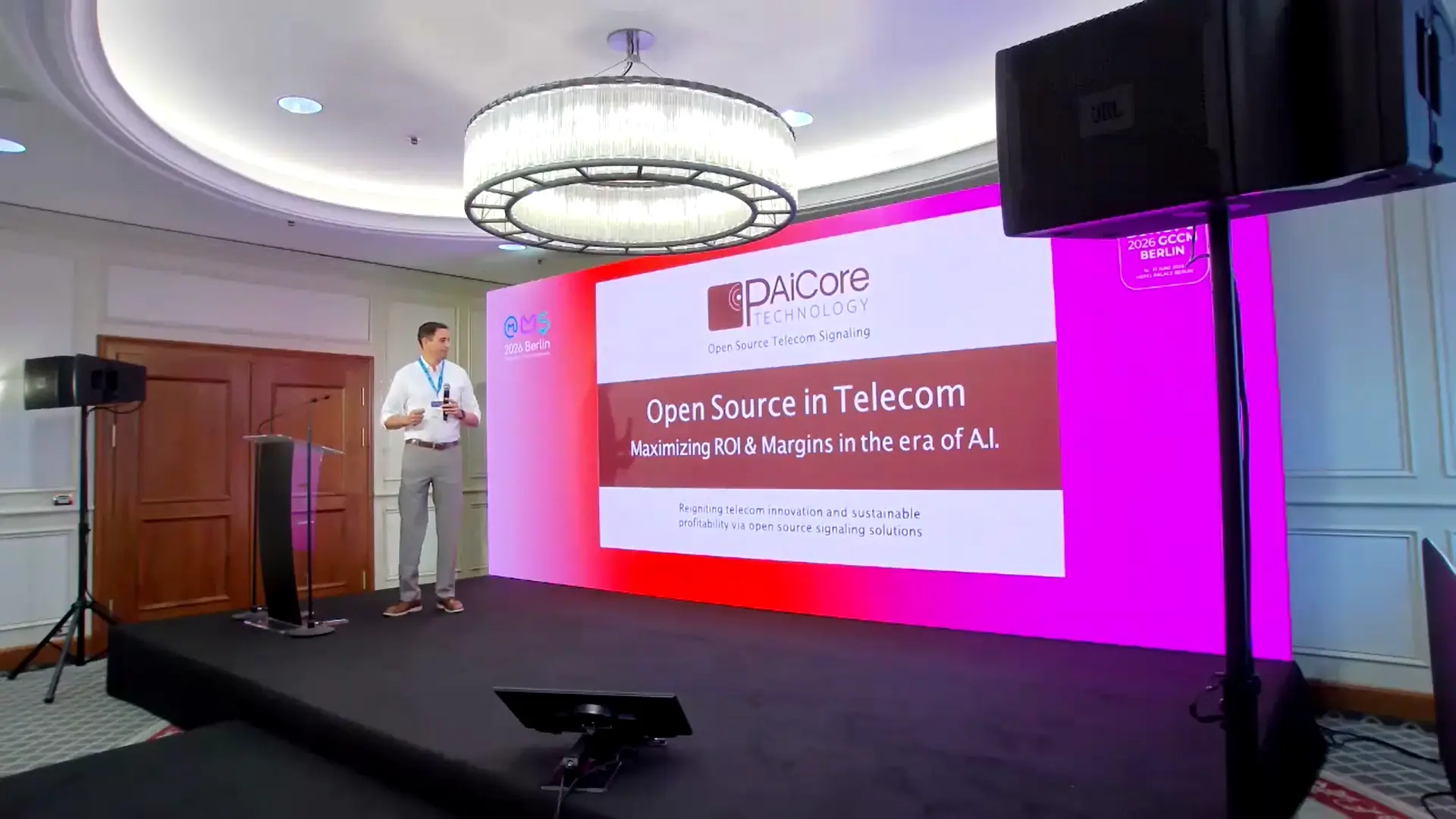
Our CEO & Founder, Celeo Arias, is featured in a Keynote Article in GCCM Magazine, published by Carrier Community. Titled “Open Source in Telecom: Maximizing ROI & Margins in the Era of A.I.,” the article is based on Celeo’s keynote presentation at Disruptive & Transformation Europe 2026 in Berlin.

Celeo Presenting at GCCM Berlin

Rethinking intellectual property in the AI era

The article opens with a question Celeo has been asking for a while: as AI changes how software gets written, what exactly are we protecting when we lock code behind proprietary licenses? 

His answer: less than we think. Open-source lowers costs, speeds up innovation, and as AI increasingly assists in writing the code itself, sidesteps a question that’s getting harder to answer cleanly: if AI generates part of an application, whose intellectual property is it, really?

The industry’s return-on-investment problem

The piece doesn’t shy away from a hard number: telecom’s return on capital has been declining for years, and the gap gets worse once you adjust for inflation. Celeo’s point is blunt:

“Keeping capital in the bank should never appear more attractive than investing in telecom innovation, yet that has increasingly become the reality”.

His prescription is a shift in mindset, not just technology: telecom is already one of the most standardized industries in the world. If networks only work because everyone agrees on 3GPP and GSMA specifications, then defending every individual piece of software as proprietary IP is inconsistent with how the industry already operates.

Open-source is already running mission-critical infrastructure

The article makes the case with companies, not competitors: Linux, Kubernetes, Apache, Android, TensorFlow open-source already underpins the infrastructure the world depends on. PAiCore’s own products sit in that same tradition, applied specifically to telecom signaling and messaging.

Where PAiCore fits

The feature includes a full breakdown of PAiCore’s open-source stack: from messaging (SMSC, SMS Signaling Firewall, SMSF, USSD Gw & USSI, PI SM Gw, RCS Application Server (Q1-27)) to signaling and geolocation (Network API Gateway, Signaling Transfer Point, Diameter Routing Agent, Security Edge Protection Proxy (Q4), GMLC & CAMARA LBS, CAMEL Gw) to business solutions like (Entitlement Configuration Server Lite, eSIM or IoT App Dev & Support, Core Network Analyzer, FIX Gw, Telephony Application Server, 3rd Party Platform Support).

Free, open-source versions are available for every product, with cost-efficient technical support plans and premium features for teams that need them.

Watch the full keynote

Carrier Community has published the full video of Celeo’s talk on their CC-Media Portal: [Watch now].

Explore PAiCore

See PAiCore’s open-source products for yourself (Browse our products) or check out our code on GitHub.

Intrigued…?

Employee Onboarding Is Becoming an Identity Security Challenge

Employee Onboarding Is Becoming an Identity Security Challenge

By PAiCore Technology ● 2 min read

Employee onboarding is traditionally treated as an HR process. But the rise of deepfakes, fabricated identities and stolen credentials is turning it into an identity security challenge.

Gartner’s February 2026 CISO Edge research, Employee Onboarding Is Now Part of the Attack Surface, highlights the growing risk, including its projection that one in four candidate profiles worldwide could be fake by 2028.

This creates a broader question:

Can organisations use additional trusted signals to strengthen identity verification?

Network-backed identity verification

The mobile network can provide one such signal.

Number Verification can help determine whether the mobile number presented during a digital journey corresponds to the subscriber and device relationship being verified.

Rather than relying only on information supplied by a user, organisations can incorporate a network-backed verification result into a broader identity or fraud-risk decision.

PAiCore’s CAMARA-compliant Number Verification API enables this capability through a standardised API interface, while the underlying operator infrastructure performs the required network-side processing.

The architecture can be represented as:

Enterprise / Digital Service → CAMARA-compliant API → Network API Gateway → Authentication / Entitlement → Mobile Network

Where PAiCore fits

This is where PAiCore’s operator-side infrastructure becomes relevant.

The PAiCore Network API Gateway provides multi-protocol interworking between modern HTTP/API environments and telecom signaling, including SS7/MAP and Diameter.

PAiCore ECS-Lite provides authentication and entitlement capabilities supporting SIM-based authentication and Silent Network Authentication.

Together, these components can provide MNOs and operators with infrastructure to expose selected network capabilities through standardised APIs without exposing underlying telecom signaling directly to enterprises.

The opportunity therefore extends beyond employee onboarding.

As enterprises look for stronger identity and fraud-prevention signals, operators can turn existing network, SIM and authentication capabilities into controlled digital services.

Employee onboarding is one potential use case.

The bigger opportunity is network-backed identity.

Explore PAiCore

PAiCore Network API Gateway 

PAiCore ECS-Lite 

Review the PAiCore Network API Gateway open-source project

Contact PAiCore

References

Read more at…