Recovery is built to forgive. Someone who has lost a password, replaced a handset, or wiped an authenticator still needs a way back into their account. Every control that makes login strong has to loosen somewhere, and this is where it loosens.
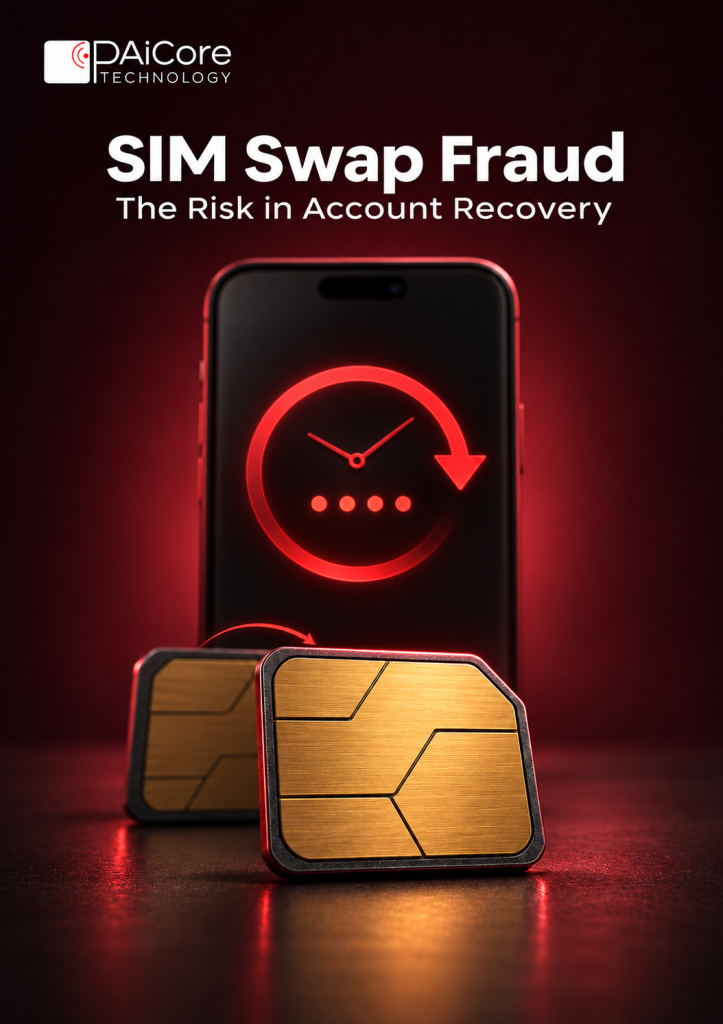
The Thomson Reuters Institute describes SIM swap fraud as a fraudster persuading a mobile carrier to transfer a victim’s number to a SIM they control, exploiting number portability. Which? has reported that unauthorised swaps are rising, and links that to how heavily services still lean on SMS codes.
Why It Slips Through
Once the number moves, the attack stops looking like an attack. The reset request comes from a plausible device. The code goes to the registered number. The code is entered correctly. A fraud engine scoring that session sees a customer who passed everything you asked of them.
The theft happened upstream, at the carrier, before the session opened. Session-level analysis cannot recover information that was never in the session.
Timing Is the Signal
A SIM change on its own means nothing. Handsets break, people upgrade, numbers port between operators every day. What carries information is the gap between the change and the request. Eighteen months is noise. Three hours is a decision.
What PAiCore’s Network API Gateway Delivers
The Gateway answers that question two ways, to suit how you have built things.
A check takes a number and a maximum age in hours and tells you whether a change happened inside it. That suits a hard gate: if true, send the customer to a stronger factor, a review queue, or a branch.
A date retrieval returns when the SIM last changed, which suits a risk engine weighing it alongside device, location, and behavioural inputs.
Before asking anything, the Gateway identifies which connected operator serves the number. If none does, the response says the service does not apply, so your system falls back deliberately instead of failing open.
Where to Put It
The placements that pay for themselves are password and PIN resets, new payee additions, high-value transfers, payout account changes for sellers and couriers, and changes to registered contact details. These are the moments where controlling a number turns into money.
Two Sources, One Platform
SIM history lives in the operator’s business support systems: the records of subscribers, SIM cards, and contracts. The Gateway reaches them through operator connectors, declarative definitions of each operator’s own API, so adding an operator is a new definition rather than new code. No signalling is involved.
Signalling APIs answer a different class of question at network level, such as authenticating a SIM against the home network, resolving the subscriber number behind an identity, or finding which node currently serves a number. Each is a defined operation with fixed inputs and outputs, authorised per partner, not open access to signalling infrastructure.
A business-system question tells you about the contract. A network question tells you about the live subscriber. The Gateway covers both under one onboarding, control, and reporting model.
What It Will Not Tell You
A SIM swap check does not identify who is holding the device, and it will not catch takeover through phishing or reused credentials. It answers one question precisely: has control of this number changed recently?
Pair it with Number Verification, which proves possession now, and you get both halves. One confirms the number is in the right hands. The other confirms it did not recently change them.
Explore the Network API Gateway at https://paicore.tech/platforms/network-api/network-api-gw/, and review the code at https://github.com/paicoretech/network-api-gateway.
News sources:
Thomson Reuters Institute, “SIM swap fraud” (https://www.thomsonreuters.com/en/institute/articles/sim-swap-fraud); Which?, “Mobile networks must step up to prevent SIM swap fraud” (https://www.which.co.uk/news/article/mobile-networks-must-step-up-to-prevent-sim-swap-fraud-aSsLN6p0CMRq)