
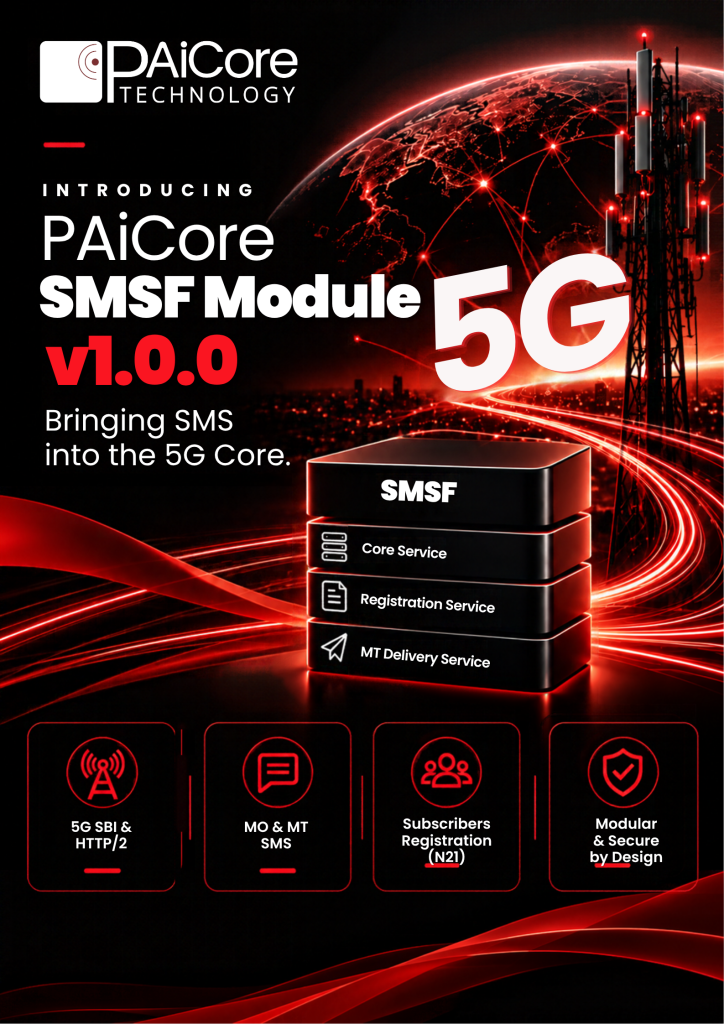
PAiCore SMSF Module v1.0.0: Bringing SMS into the 5G Core
- October 23, 2026
4 min read
As mobile networks move toward 5G, operators still need to support essential services such as SMS while adopting the 5G Core’s service-based architecture.
PAiCore Technology has released SMSF Module v1.0.0, a Short Message Service Function (SMSF) for 5G Standalone (SA) networks. It lets operators carry SMS through the 5G Core while their existing SMSC continues to handle routing, delivery, charging and reporting.
SMSF provides the connection between the 5G Core and the existing SMSC. It serves the Access and Mobility Management Function (AMF) over the HTTP/2-based Service-Based Interface (SBI), processes both mobile-originated (MO) and mobile-terminated (MT) SMS, manages subscriber SMS context and registers subscribers with the Unified Data Management (UDM) over N21.
Version 1.0.0 is the module’s first feature and platform-integration baseline, establishing the core capabilities required for SMS processing in a 5G Core environment.
Where the SMSF fits
In 5G SA, SMS travels as NAS signalling between the device and the AMF, and the SMSF handles the short message itself (3GPP TS 23.501; procedures in TS 23.502). The SMSF offers the Nsmsf_SMService to the AMF (TS 29.540) and registers as the subscribers serving SMSF in the UDM over N21 (Nudm_UECM, TS 29.503).
PAiCore SMSF takes this 5G-facing role and passes messages to the existing SMSC for processing. Traffic flows 5G Core → SMSF → SMSC routing and delivery → SMSF → 5G Core. Operators planning SMS over NAS for roaming subscribers can refer to GSMA PRD NG.113, 5GS Roaming Guidelines.
What v1.0.0 includes
Service-based interface toward the AMF
The core service exposes Nsmsf_SMService endpoints for UE SMS context activation and deactivation and for uplink (MO) SMS, as defined in TS 29.540. It also receives N1/N2 message transfer failure notifications from the AMF (Namf_Communication, TS 29.518).
Transport follows the SBI conventions of TS 29.500: HTTP/2 (IETF RFC 9113), configurable concurrent-stream limits and ProblemDetails error responses (RFC 7807). TLS 1.3 (RFC 8446) and mutual TLS are configured per gateway, as provided for in the 5G security architecture (TS 33.501).
Subscriber registration over N21
UE SMS context is held per SUPI, with ETag-based conditional update and deletion (RFC 9110). When the AMF activates or deactivates SMS, the SMSF answers the AMF at once and forwards the registration or deregistration to the UDM separately. The UDM is discovered per subscriber through the NRF (TS 29.510), so a slow or unavailable UDM does not delay the AMF response.
Mobile-originated SMS
MO TPDUs are decoded according to TS 23.040, covering the GSM 7-bit default alphabet and UCS2 (TS 23.038), TON/NPI, the User Data Header and concatenated (multipart) SMS. Segments are held until the message is complete, with a configurable expiry for incomplete sets. The message then enters the SMSC routing flow, and delivery reports are correlated and returned through it.
Integration with SMSC routing
SMSF traffic uses the SMSC’s existing rules engine. Rules match on origin and destination address, TON/NPI, IMSI, content, SCCP data and custom parameters, and can rewrite addresses, prefixes, content and signalling settings.
For 5G destinations, the GPSI is resolved to a SUPI against the active UE SMS context (identifiers per TS 23.003). If the subscriber is unavailable, routing falls through to the next eligible destination. Messages are then queued to high, medium or low-priority delivery.
Mobile-terminated delivery
The MT service delivers SMS to the AMF with Namf_Communication N1N2MessageTransfer (TS 29.518), applying per-priority throughput limits and building multipart TPDUs. Failures, including those the AMF reports back, trigger retry or rerouting to an alternate destination under the configured policy. Each message closes with a final CDR, an optional delivery report and, where applicable, a charging refund.
NRF registration and OAuth 2.0
The core service registers the SMSF with the NRF and handles heartbeat, deregistration and re-registration after an NRF 404 (Nnrf_NFManagement, TS 29.510). It obtains OAuth 2.0 access tokens (RFC 6749) for the AMF and UDM separately, each with its own expiry handling, following the SBA authorisation model in TS 33.501. Inbound tokens are validated as JWTs (RFC 7519) against the NRF’s published key set (JWK, RFC 7517), with a bounded cache of verified tokens.
Architecture and operations
The SMSF is split into separately packaged services that scale and restart independently.
Service | Responsibilities |
Core | AMF-facing SBI, UE SMS context, MO processing, NRF registration and token acquisition |
Registration | Asynchronous UDM registration over N21, NRF-based UDM discovery |
MT delivery | Priority queues, N1N2MessageTransfer to the AMF, delivery outcomes |
Shared layer | TPDU encoding and decoding, HTTP/2, security, message-flow contracts |
N21 registration and MT delivery start only once valid credentials are available, and tokens are refreshed ahead of expiry. If credentials lapse or the AMF connection drops, processing pauses instead of sending on an invalid connection. An AMF watchdog reconnects and resumes MT delivery automatically.
Each service runs a separate stack per network identifier, so one platform can serve several networks. Management APIs validate HTTP/2 gateways and their inbound, outbound, NRF and UDM security profiles. Gateways can be started, stopped, refreshed or deleted without a process restart.
A unified CDR supports end-to-end tracing of each message. The principal SMSF flows are covered by unit, functional and end-to-end tests.
Availability
SMSF Module v1.0.0 was released in October 2026 as the first SMSF feature and platform-integration baseline for PAiCore’s 5G messaging portfolio.
Standards referenced
Body | Document | Title | Relevance |
3GPP | TS 23.501 | System architecture for the 5G System | SMSF role, N20 and N21 |
3GPP | TS 23.502 | Procedures for the 5G System | SMS over NAS procedures |
3GPP | TS 29.500 | Technical realization of Service Based Architecture | HTTP/2 SBI, ProblemDetails |
3GPP | TS 29.540 | SMS Services; Stage 3 | Nsmsf_SMService |
3GPP | TS 29.518 | Access and Mobility Management Services; Stage 3 | N1N2MessageTransfer, failure notification |
3GPP | TS 29.503 | Unified Data Management Services; Stage 3 | Nudm_UECM (N21) |
3GPP | TS 29.510 | Network Function Repository Services; Stage 3 | NF registration, discovery, access tokens |
3GPP | TS 33.501 | Security architecture and procedures for 5G system | TLS, mTLS, OAuth 2.0 on the SBA |
3GPP | TS 23.040 | Technical realization of the Short Message Service | TPDU, UDH, concatenation |
3GPP | TS 23.038 | Alphabets and language-specific information | GSM 7-bit, UCS2 |
3GPP | TS 23.003 | Numbering, addressing and identification | SUPI, GPSI |
IETF | RFC 9113 | HTTP/2 | SBI transport |
IETF | RFC 8446 | TLS 1.3 | Transport security |
IETF | RFC 6749 | OAuth 2.0 Authorization Framework | Access tokens |
IETF | RFC 7519, RFC 7517 | JSON Web Token; JSON Web Key | Token validation |
IETF | RFC 7807 | Problem Details for HTTP APIs | Error responses |
IETF | RFC 9110 | HTTP Semantics | ETag conditional requests |
GSMA | 5GS Roaming Guidelines | SMS over NAS in roaming |
page.