Supporting Seamless SMS Delivery During the Transition from 2G/3G to 5G
- November 11, 2026
3 min read
Supporting Seamless SMS Delivery During the Transition from 2G/3G to 5G
As mobile network operators across Europe transition from legacy 2G and 3G networks to 5G, maintaining reliable SMS communication across different network generations remains an important operational requirement.
According to a press release published by France’s telecommunications regulator, Arcep, on 30 March 2026, French mobile operators have established timelines for phasing out their 2G and 3G networks between the end of March 2026 and 2029. During this transition, legacy networks will continue operating, requiring operators to support SMS communication across both legacy and 5G infrastructures.
This creates a need for consistent message processing, routing, and delivery regardless of the underlying network technology.
Processing SMS Across Legacy and 5G Networks
When a mobile-originated SMS reaches the Short Message Service Function (SMSF), it arrives as a TPDU (Transfer Protocol Data Unit) encapsulated within a NAS (Non-Access Stratum) message.
Before the message can enter the routing process, the SMSF must correctly parse and interpret its contents. This includes extracting essential information such as:
Destination address
Type of Number (TON) and Numbering Plan Indicator (NPI)
Data Coding Scheme (DCS)
User Data
Accurate parsing and interpretation at this stage are essential for ensuring that messages are processed and routed correctly. Errors during decoding can affect subsequent message handling and delivery.
How PAiCore SMSF Handles Message Decoding and Reassembly
PAiCore SMSF Module v1.0.0 supports the processing of SMS messages across different encoding formats and message structures.
Its key capabilities include:
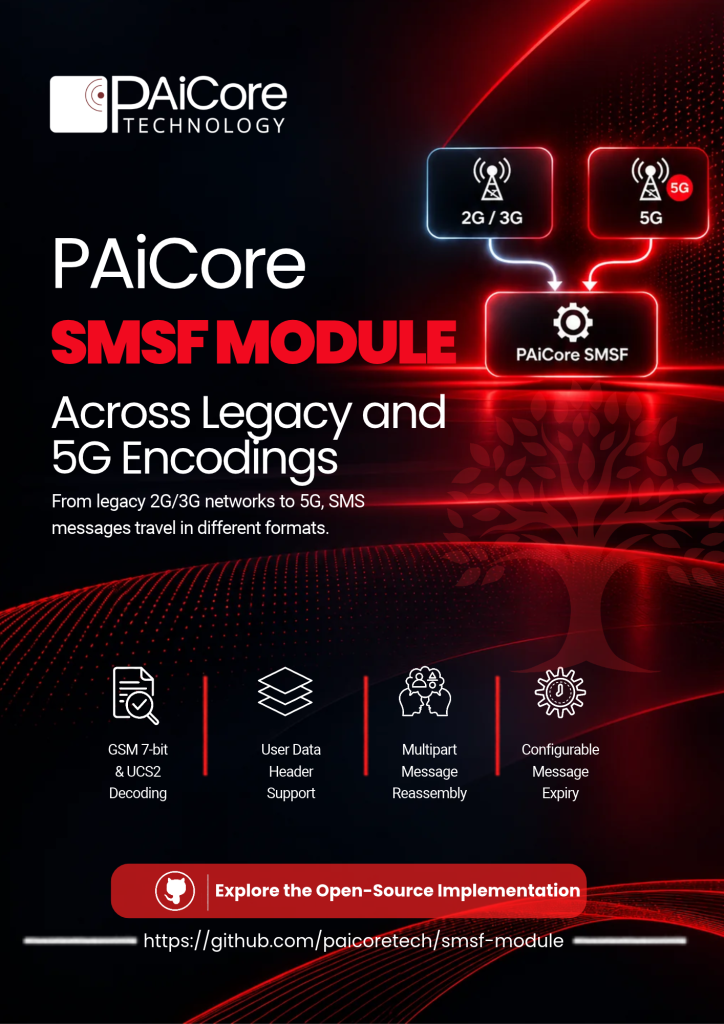
GSM 7-bit and UCS2 Decoding
Supports the decoding of GSM 7-bit and UCS2 encoded messages, enabling the SMSF to process standard text and Unicode content.
User Data Header (UDH) Support
Reads and interprets the User Data Header, which carries additional information required for handling structured and concatenated SMS messages.
Multipart Message Reassembly
Reassembles multipart SMS messages into a single logical message, ensuring that long messages divided into multiple segments can be processed and delivered together.
Configurable Message Expiry
Multipart message reassembly requires maintaining temporary state while individual message segments arrive. PAiCore SMSF holds received segments until all parts are available or a configurable expiry period is reached.
This expiry mechanism helps manage incomplete or interrupted message transmissions while preventing message fragments from remaining in memory indefinitely.
Unified Message Routing and Delivery
Once a message has been decoded, validated, and normalized, it enters the platform’s routing workflow.
PAiCore applies a unified routing engine across multiple communication interfaces and protocols, including:
SMPP
HTTP
SS7
Diameter
SIP
5G
This approach enables messages originating from different network environments to follow a consistent processing and routing workflow.
Delivery reports are also handled through the platform’s delivery flow, allowing the message originator to receive the delivery outcome, including when messages travel through a 5G network path.
Maintaining Consistent SMS Communication During Network Evolution
The gradual retirement of 2G and 3G networks does not eliminate the need for reliable SMS communication. Instead, it introduces a period in which operators must support multiple network generations simultaneously.
With message decoding, UDH processing, multipart reassembly, configurable expiry, and unified routing, PAiCore SMSF supports consistent SMS handling across legacy and 5G network environments.
For mobile network operators, this means subscribers can continue to experience consistent SMS processing and delivery as they move between legacy and next-generation mobile networks.
Source: Arcep, Mobile networks, Press Release, 30 March 2026.