Keeping Subscribers Reachable Across Networks with PAiCore SMSF
- November 13, 2026
3 min read
Keeping Subscribers Reachable Across Networks with PAiCore SMSF
Category: 5G Messaging | Network Interoperability | SMSF
As mobile operators transition towards 5G Standalone (5G SA), maintaining messaging continuity across legacy and next-generation network environments requires accurate subscriber identification and intelligent routing.
With subscribers identified through different addressing schemes across network generations, resolving subscriber identities is an important part of message delivery. PAiCore SMSF addresses this requirement through GPSI-to-SUPI identity resolution, configurable routing policies, and priority-based message handling.
The Challenge of Subscriber Identity Across Networks
The evolution towards 5G Standalone introduces differences in how subscriber identities are represented and resolved across network domains.
Bharti Airtel recently stated that its 5G network is fully Standalone-ready, while its Fixed Wireless Access (FWA) service already operates entirely on standalone 5G. The update, reported during Airtel’s Q4 FY26 earnings call, illustrates the growing operational scale of 5G SA deployments.
In a mixed-network environment, a legacy network may address a subscriber using MSISDN and IMSI, while a 5G Core may identify the same subscriber using SUPI or GPSI.
Successful message delivery depends on resolving these identities correctly before selecting the appropriate routing destination.
When identifiers cannot be resolved, a message may fail to match an active subscriber context and be rejected, even when the subscriber is reachable through another eligible network path.
GPSI-to-SUPI Identity Resolution
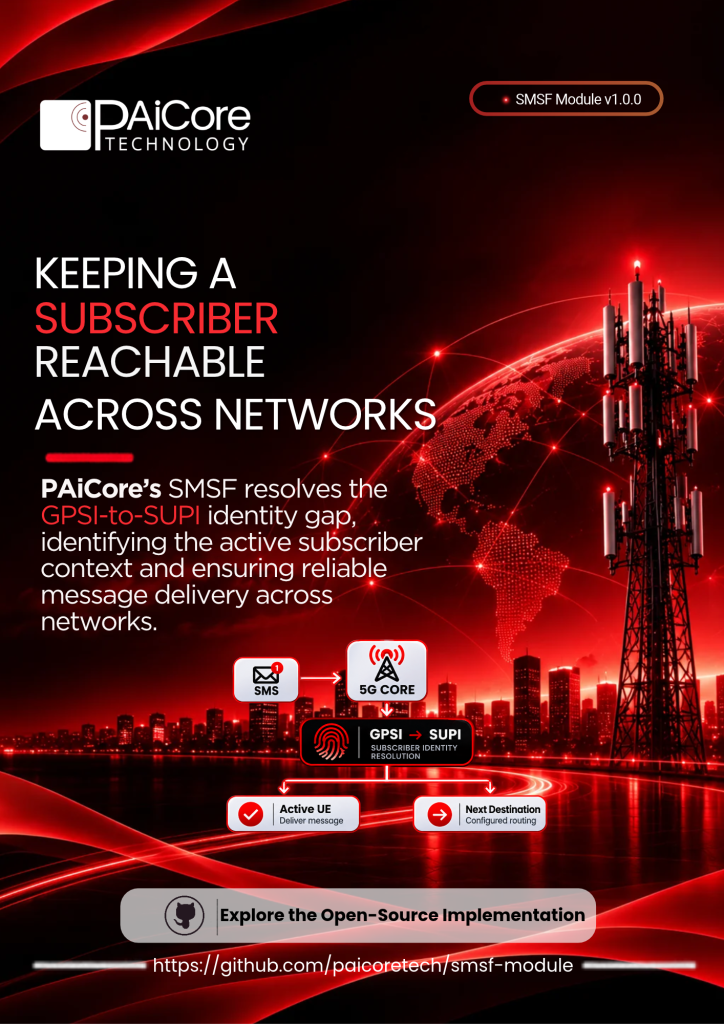
PAiCore SMSF Module v1.0.0 addresses this challenge by resolving an active UE SMS context from GPSI to SUPI before routing.
The process determines whether an active subscriber context is available for message delivery. When no active context exists, the subscriber is treated as unavailable, and the message moves to the next eligible destination according to the configured routing rules.
This mechanism enables the SMSF to make routing decisions based on subscriber context rather than relying solely on the destination address.
Configurable Routing Rules and Message Processing
Subscriber identity resolution is only one part of the messaging process. Operators also need control over how messages are evaluated, modified, and dispatched across different network destinations.
PAiCore SMSF provides configurable routing rules that operate on multiple message and signaling parameters, including:
Origin, source, and destination addresses
Type of Number (TON) and Numbering Plan Indicator (NPI)
IMSI
Message content
SCCP data
Custom parameters
Based on the configured conditions, routing actions can rewrite addresses and prefixes, modify message content, and adjust signaling settings before dispatch.
This allows operators to apply routing policies according to subscriber information, message characteristics, and network requirements.
Priority-Based Message Delivery
Different messaging services have different delivery requirements. One-time passwords (OTPs), authentication messages, and other time-sensitive communications require different handling from bulk messaging traffic.
PAiCore SMSF supports priority-based routing through three delivery levels:
High Priority
Medium Priority
Low Priority
Matched traffic is directed into the appropriate priority flow, ensuring that time-sensitive messages, such as OTPs, are not queued behind bulk traffic.
This gives operators greater control over message processing and allows delivery priorities to reflect the requirements of individual messaging services.
Unified Multi-Protocol Routing
Managing routing policies independently across different network technologies can introduce operational complexity and inconsistent behaviour.
PAiCore addresses this through a shared routing engine used across the platform. Operators can maintain a common routing policy across multiple protocols, including:
SS7 – Signaling System No. 7
Diameter – Diameter-based network signaling
SMPP – Short Message Peer-to-Peer
HTTP – Hypertext Transfer Protocol
SIP – Session Initiation Protocol
5G – Fifth-generation mobile network traffic
Because the routing engine is shared, policy changes apply consistently across supported protocols. Operators can maintain a unified approach to routing without managing entirely separate policies for each network technology.
Enabling Messaging Continuity in 5G Networks
As mobile operators expand their 5G Standalone infrastructure, accurate subscriber identity resolution, flexible routing, and delivery prioritisation become increasingly important to messaging continuity.
PAiCore SMSF combines GPSI-to-SUPI identity resolution, configurable routing rules, priority-based message handling, and shared multi-protocol routing to support message delivery across interconnected network environments.
By bringing these capabilities together, PAiCore SMSF helps operators manage subscriber reachability and messaging requirements as their networks evolve towards 5G Standalone.
Explore PAiCore SMSF Module
Discover the PAiCore SMSF Module v1.0.0 and its capabilities for native SMS in 5G Standalone networks.
Product Page:
https://paicore.tech/platforms/messaging/smsc-smsf/
GitHub Repository:
https://github.com/paicoretech/smsf-module
News source:
TelecomTalk, “Airtel Says 5G Network Is Fully SA Ready, FWA Already Runs on Standalone 5G” (https://telecomtalk.info/airtel-says-5g-network-is-fully-sa-ready-fwa-already-runs-on-standalone-5g/1007589/)