Open Source Is Becoming Standard Practice in Telecom
- November 17, 2026
2 min read
The Telecom Industry Is Moving Towards Open Standards
ETSI’s Open Operator Platform, OpenOP, delivers an open-source, standards-based stack aligned with GSMA Operator Platform Group specifications. The release reflects a wider industry direction: operators want shared, inspectable foundations for network functions, so that integration work is reusable and vendor choices remain open.
Why Open Source Alone Is Not Enough
Open source solves part of this problem. Standard interfaces solve the rest. A messaging function that is open but uses custom interfaces still forces operators into bespoke integration work.
PAiCore SMSF: Built on 3GPP Service-Based Interfaces
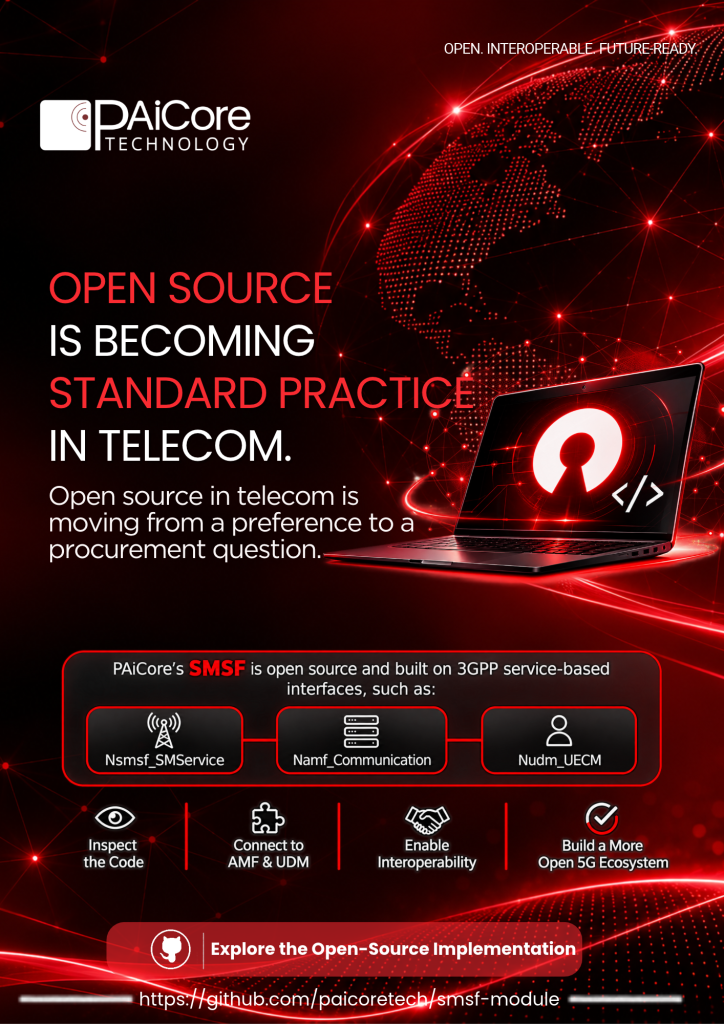
PAiCore’s SMSF Module v1.0.0 is published as open source on GitHub and implements the SMSF role using 3GPP service-based interfaces. It exposes Nsmsf_SMService to the AMF over HTTP/2, uses Namf_Communication N1N2MessageTransfer to deliver mobile-terminated messages, and uses Nudm_UECM to forward registrations to the UDM. These are the procedures other 5G core functions expect, so the SMSF can interoperate with AMF and UDM functions from different sources.
Security Through Standardized Interfaces
Security interfaces follow the same standards-first approach. The module uses TLS 1.3 with mutual TLS on each gateway, and OAuth2 tokens are issued through the NRF and validated as JWTs against the NRF’s JWKS.
Building an Open and Interoperable Telecom Ecosystem
Open source gives operators the ability to inspect and adapt the software. Standard interfaces give them the ability to connect it. Together, they make the SMS function a component operators can plan around, rather than one they must rebuild each time a vendor changes.
Explore PAiCore SMSF
Discover the PAiCore SMSF Module v1.0.0 and its capabilities for native SMS in 5G Standalone networks.
Product page: PAiCore SMSC / SMSF
GitHub repository: PAiCore SMSF Module
News source
ETSI Newsroom