
Standardizing password reset has historically been a challenge, with most organizations settling on the SMS-OTP as the default second factor. However, this relies heavily on user interaction and external delivery channels, introducing significant friction during a high-stakes moment where the user is already locked out. Forced context switching, leaving the application to retrieve a code, frequently leads to session abandonment and increased customer support overhead, particularly for high-growth platforms where user retention is critical.
By leveraging Silent Network Authentication, organizations can re-engineer the password reset journey into a seamless, background operation. Instead of sending a one-time code to be manually entered, the application performs a real-time handshake directly with the Mobile Network Operator. This process leverages the deterministic nature of the cellular connection to confirm that the hardware-level credentials of the SIM card match the identity associated with the account, all without a single tap from the user.
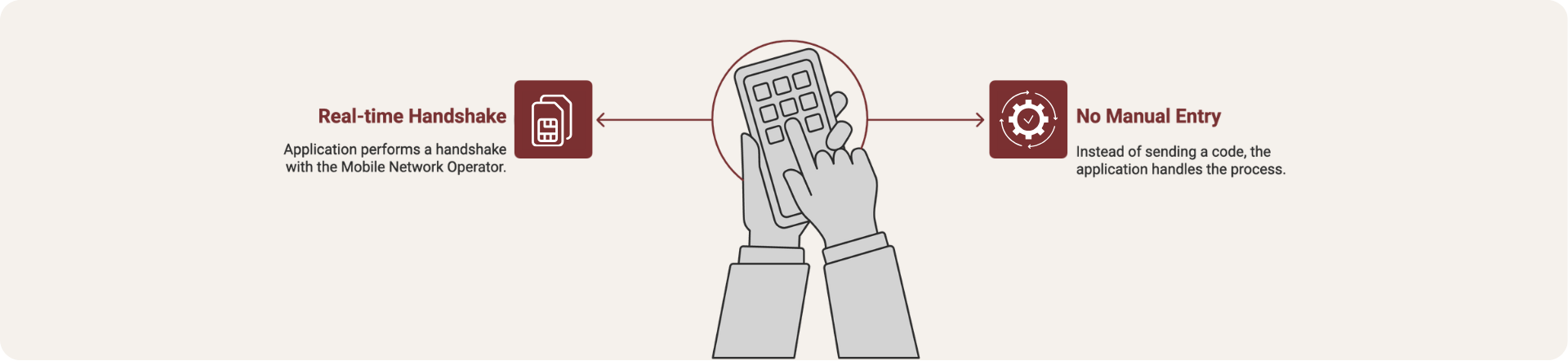
This transition to invisible but robust verification offers two major advantages for secure account recovery:
Phishing and Social Engineering Mitigation
By eliminating interceptable, shareable codes, the primary attack vector for fraudulent password resets is removed. Verification relies on the physical possession of the network identity (the device itself), not on the knowledge of a shared secret.
Streamlined UX and Improved Trust
Completing a password reset in seconds without leaving the app maintains the user within the organization’s trusted environment. This increases the overall perception of security and prevents drop-offs during this critical interaction.
Moving away from legacy OTP systems toward silent authentication doesn’t just improve security, it transforms a point of high friction into a moment of brand trust.