PAiCore TechnologyLet’s talk ↗

The Silent Login: How Telecom Networks Are Redefining App Onboarding

The Silent Login: How Telecom Networks Are Redefining App Onboarding

By PAiCore Technology ● < 1 min read

The first interaction with an app often defines whether a user stays or leaves. And yet, onboarding is still filled with friction, passwords and verification steps that interrupt the experience before it even begins.

Silent authentication is changing that.

Instead of asking users to prove who they are, the mobile network already holds a strong signal of their identity. When a user opens an app for the first time on their mobile device, a background handshake takes place between the application and the Mobile Network Operator.

Through this process, the cellular connection itself—deterministic, hardware-bound, and operator-verified—confirms that the device in hand is associated with a valid subscriber. No codes, no credentials, no user interaction required.

This shifts authentication away from the application layer and into the network layer, where identity is anchored to the SIM or eSIM and validated directly by the operator’s infrastructure.

The result is a high-trust onboarding experience that feels invisible to the user but significantly reduces exposure to common risks such as SMS interception, fake account creation, and bot-driven registrations.

What used to be the most fragile step in the user journey becomes one of the strongest, quietly handled by the network.

Contact PAiCore Technology to learn more about Silent Authentication.

Strengthening Digital Identity with Silent Authentication

Strengthening Digital Identity with Silent Authentication

By PAiCore Technology ● < 1 min read

The shift toward passwordless authentication is already underway.

Technologies like passkeys and FIDO2 are redefining how users prove who they are—replacing passwords with cryptographic keys stored on their devices. It’s a strong model, and adoption is growing fast. But even in this new approach, user interaction is still part of the process: a biometric scan, a PIN, a confirmation.

Silent authentication enters at a different layer, rather than replacing these mechanisms, it complements them by validating something they don’t fully cover: that the device itself is genuinely present on the mobile network, authenticated through SIM-based credentials tied to a real subscriber.

It introduces a network-based possession factor, using real-time validation to make common attack vectors, such as phishing, credential theft, or remote access, significantly harder to exploit.

That distinction becomes more relevant as digital identity frameworks evolve.

Contact PAiCore Technology to learn more about Silent Authentication.

Silent Authentication in emergency response and public safety

Silent Authentication in emergency response and public safety

By PAiCore Technology ● < 1 min read

In healthcare, access control is critical, but so is speed.

Doctors, nurses, and staff need to move quickly between systems, often under pressure. Traditional authentication methods, while secure, can introduce delays that disrupt workflows and impact patient care.

Silent authentication offers a way to verify identities in real time. By leveraging the mobile network, healthcare applications can confirm that the right person is accessing sensitive data without requiring repeated logins or additional steps. Access is granted in milliseconds, without requiring codes, passwords, or interrupting the clinical workflow.

Healthcare data protection regulations (whether HIPAA in the United States, GDPR in Europe, or equivalent frameworks across Latin America) require strong authentication for access to protected health information. Silent Authentication, grounded in operator-validated hardware credentials and cryptographic session verification, meets and exceeds the technical requirements of multi-factor authentication as defined by these frameworks.

In healthcare, every second counts. Silent Authentication ensures that security never costs one.

Contact PAiCore Technology to learn more about Silent Authentication.

Simplifying IoT security with Silent Authentication

Simplifying IoT security with Silent Authentication

By PAiCore Technology ● < 1 min read

IoT devices operate differently from traditional user-driven systems, they connect, communicate, and run continuously without human input. In this context, authentication models built around passwords, OTPs, or user approvals don’t translate well into machine-to-machine environments, often adding unnecessary complexity or creating security gaps at scale.

Silent authentication takes a different path.

Instead of relying on external credentials, it uses the device’s network identity as the authentication factor. Each device, through its SIM or eSIM, carries operator-verified credentials, such as the IMSI and cryptographic keys, that are hardware-bound and cannot be replicated through software.

By leveraging the mobile network core, devices can authenticate directly and silently with backend systems, without any manual interaction.

For large IoT deployments, this enables:

Zero-touch provisioning

Continuous device verification

Scalable authentication without credential management overhead

Less friction, fewer moving parts and a model that aligns better with how IoT actually works.

Contact PAiCore Technology to learn more about Silent Authentication.

Silent Authentication and the fight against SIM Swap Fraud

Silent Authentication and the fight against SIM Swap Fraud

By PAiCore Technology ● < 1 min read

SIM swap fraud remains one of the most damaging attack vectors across telecom and financial services, especially in emerging markets.

The consequences are immediate. Victims can lose access to their accounts within minutes, financial losses are often irreversible, and operators face both reputational and regulatory exposure.

At its core, most systems still treat the phone number as a proxy for identity. SMS-based authentication assumes that whoever controls the number is the legitimate user, and this is not always the case.

Silent authentication approaches identify validation differently. Instead of relying on the phone number, it validates the physical SIM or eSIM credentials directly within the mobile network.

This creates a binding between the user’s account and the hardware elements of their device such as the IMSI, the cryptographic keys securely stored in the SIM, and the active session data managed by the operator.

When a SIM swap occurs, the attacker may gain control of the number, but not the original hardware credentials tied to the user’s identity.

This shift is particularly relevant in regions where SIM swap fraud is more prevalent, such as Latin America, where mobile banking adoption has grown rapidly and identity verification processes are not always standardized.

Rather than adding more layers to an already fragile system, silent authentication reduces reliance on the weakest link.

Contact PAiCore Technology to learn more about Silent Authentication.

Silent Authentication: The Backend Handshake

Silent Authentication: The Backend Handshake

By PAiCore Technology ● < 1 min read

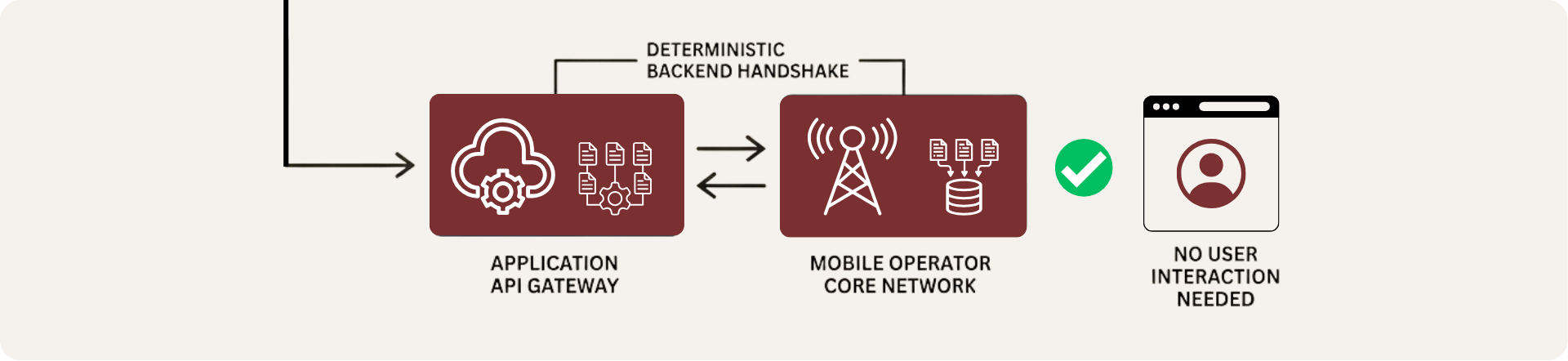
Silent Authentication is more than just a UI enhancement; it is a technical orchestration occurring within the deep layers of the network. While the user experiences instantaneous validation, the system executes a deterministic backend handshake between the application’s API Gateway and the mobile operator’s Core Network, completely removing the need for human interaction.

This process relies on robust signaling protocols that directly query the telecommunications infrastructure through the following mechanisms:

AAA Protocols (Diameter/Radius)

Establishing secure, direct communication with the operator’s authentication servers.

EAP-AKA Challenge

Generating a cryptographic challenge that only the physical SIM card can resolve, uniquely linking identity to actual hardware.

Real-time Validation

Confirming that the active data session matches exactly with the subscriber registered in the network core.

By operating at the network layers (Layer 3/4), this method is immune to application-level attacks, such as trojans designed to intercept SMS. Security shifts from a “shared secret” prone to human error to a foundation of physical device possession and cellular network integrity, effectively neutralizing critical vectors like SIM swapping and phishing.

The Backend Handshake simplifies digital trust. By moving verification to the network, it creates a seamless security model that turns a major point of friction into a reliable, invisible experience.

Contact PAiCore Technology to learn more about Silent Authentication.

Silent Authentication: Redefining Password Recovery

Silent Authentication: Redefining Password Recovery

By PAiCore Technology ● 2 min read

Standardizing password reset has historically been a challenge, with most organizations settling on the SMS-OTP as the default second factor. However, this relies heavily on user interaction and external delivery channels, introducing significant friction during a high-stakes moment where the user is already locked out. Forced context switching, leaving the application to retrieve a code, frequently leads to session abandonment and increased customer support overhead, particularly for high-growth platforms where user retention is critical.

By leveraging Silent Network Authentication, organizations can re-engineer the password reset journey into a seamless, background operation. Instead of sending a one-time code to be manually entered, the application performs a real-time handshake directly with the Mobile Network Operator. This process leverages the deterministic nature of the cellular connection to confirm that the hardware-level credentials of the SIM card match the identity associated with the account, all without a single tap from the user.

This transition to invisible but robust verification offers two major advantages for secure account recovery:

Phishing and Social Engineering Mitigation

By eliminating interceptable, shareable codes, the primary attack vector for fraudulent password resets is removed. Verification relies on the physical possession of the network identity (the device itself), not on the knowledge of a shared secret.

Streamlined UX and Improved Trust

Completing a password reset in seconds without leaving the app maintains the user within the organization’s trusted environment. This increases the overall perception of security and prevents drop-offs during this critical interaction.

Moving away from legacy OTP systems toward silent authentication doesn’t just improve security, it transforms a point of high friction into a moment of brand trust.

Contact PAiCore Technology to learn more about Silent Authentication.

Device Binding: Turning the Smartphone into a Secure Hardware Key

Device Binding: Turning the Smartphone into a Secure Hardware Key

By PAiCore Technology ● 2 min read

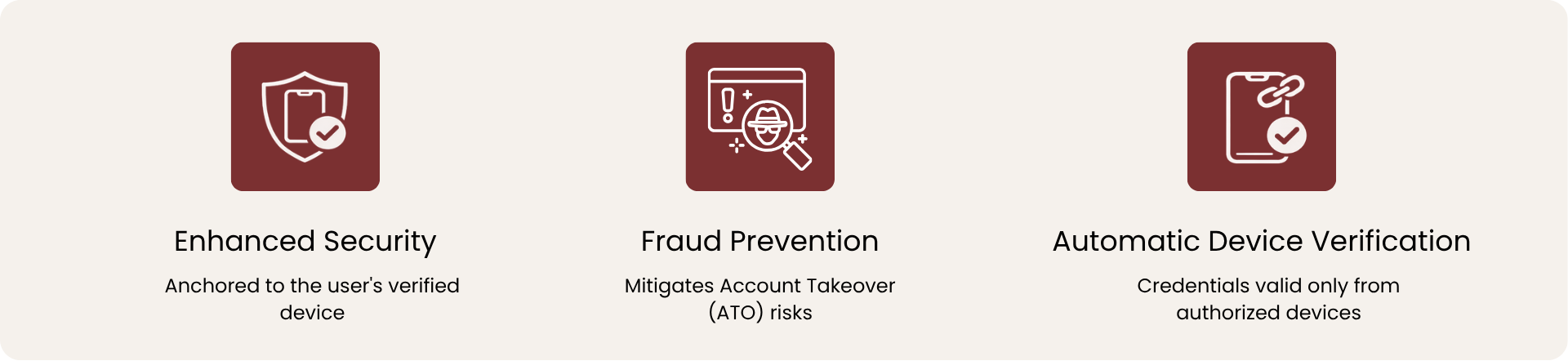
In today’s security ecosystem, Device Binding has become a cornerstone for mitigating Account Takeover (ATO) fraud. This technique establishes a unique and persistent relationship between a user’s account and their physical hardware, ensuring that credentials are only valid when presented from an authorized terminal. 

By anchoring a digital identity to the phone’s physical elements, security shifts from relying solely on what a user knows (like a password) to what the user possesses (their verified device).

This binding method leverages mobile network infrastructure to transform the smartphone into an invisible security token, providing three critical benefits for authentication architecture:

Mitigation of remote attacks

Even if an attacker obtains a user's credentials, access is blocked because they lack the physical device linked to the account.

Frictionless authentication

By deterministically recognizing the hardware, the system enables Silent Authentication flows that eliminate the need for additional verification steps in every session.

Ecosystem integrity

This allows for the immediate detection of accounts being used in new environments, emulators, or devices that do not meet security requirements.

The technical implementation of this “anchoring” typically relies on unique identifiers validated directly by the operator, such as IMEI or IMSI, or through cryptographic tokens stored in the terminal’s secure enclave. 

The result is a bank-grade security layer that is completely invisible to the end user, removing the need for external authentication devices while guaranteeing that access is always legitimate.

Contact PAiCore Technology to learn more about Silent Authentication.

Modernizing Mobile Identity: The CAMARA Number Verification API

Modernizing Mobile Identity: The CAMARA Number Verification API

By PAiCore Technology ● 2 min read

The CAMARA Number Verification API represents a fundamental shift toward seamless identity confirmation by allowing businesses to verify mobile number ownership directly from the user’s device. By eliminating the reliance on manual inputs like SMS codes, this service significantly streamlines critical workflows such as account creation, secure login, and transaction validation. 

The primary advantage of this standard is its ability to provide a high-trust verification layer that simultaneously enhances the user experience and operational efficiency, ensuring that the phone number being used is definitively associated with the physical device in hand.

This reliable authentication is achieved through two primary technical mechanisms that leverage the mobile network’s inherent intelligence. 

The first is network-based authentication, which focuses on the direct identification of the mobile phone through the operator's infrastructure. Since a network operator manages the data connection, it inherently knows which subscriber a connected mobile phone belongs to and what its associated phone number is.

The second mechanism is SIM-based authentication, which identifies the specific subscriber’s SIM or eSIM installed in the user's device. This approach relies on temporary tokens provided by the operator, following the rigorous security standards defined by GSMA TS.43 and GSMA ASAC.

These methods ensure that the authentication is not just based on a temporary network session, but on the persistent, secure credentials embedded within the mobile hardware. Together, these mechanisms provide a practical, fraud-resistant solution for industries that require accurate, real-time phone number verification in a world where speed and security must coexist.

Contact PAiCore Technology to learn more about Silent Authentication.