
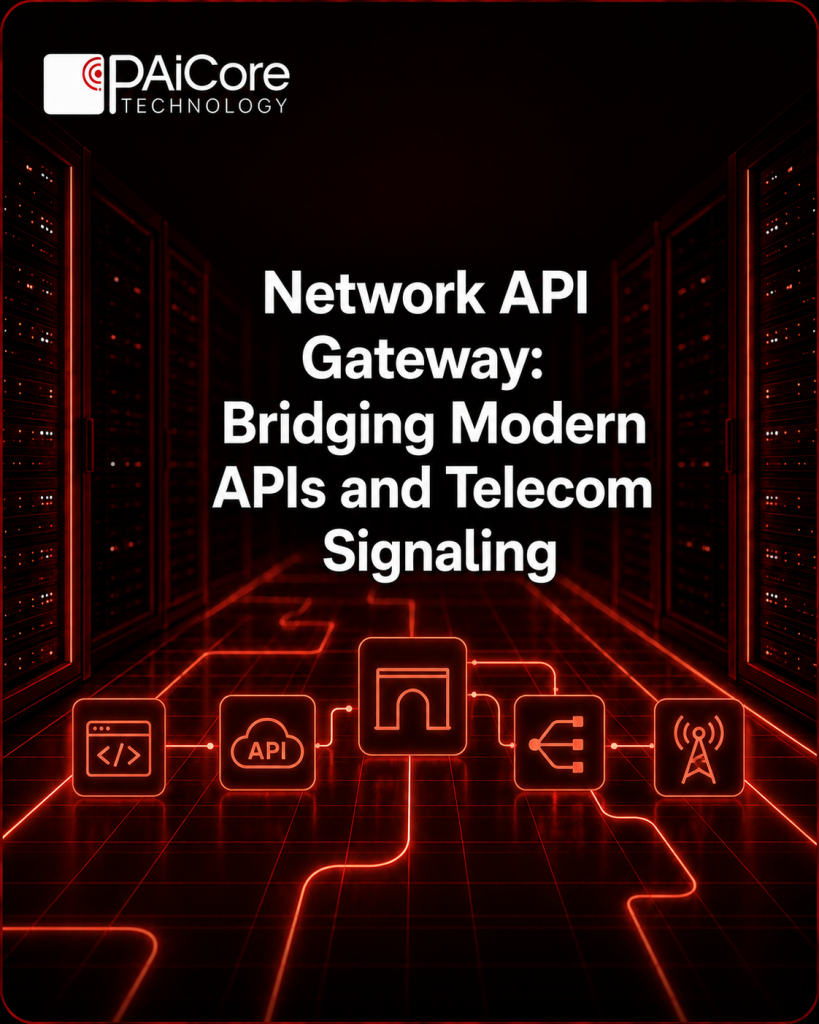
Network API Gateway: Bridging Modern APIs and Telecom Signaling
By PAiCore Technology ● 3 min read
Network APIs are making it possible for applications to access capabilities traditionally embedded inside mobile operator networks.
Use cases such as Number Verification, Location Verification, fraud prevention, and Quality on Demand can increasingly be exposed through standardised APIs.
But while the API presented to a developer may be simple, the network infrastructure behind it often isn’t.
A modern Network API may ultimately need to interact with telecom technologies such as SS7, MAP, SIGTRAN, Diameter, HLR/AuC, HSS, or 3GPP AAA.
Connecting these environments reliably is one of the key architectural challenges in implementing Network APIs.
The Role of a Network API Gateway
A Network API Gateway provides the translation and orchestration layer between modern application interfaces and telecom signaling infrastructure.
Conceptually, the architecture looks like:
Application → HTTP/REST → Network API Gateway → SS7/MAP or Diameter → Mobile Network
This approach allows application developers to consume network capabilities through familiar API interfaces without requiring them to implement telecom-specific signaling stacks.
It also aligns with the industry’s move toward standardised Network APIs.
GSMA Open Gateway provides a framework for exposing operator network capabilities through common APIs, while CAMARA develops standardised API specifications designed to simplify application-to-network integration.
Why Multi-Protocol Interworking Matters
Operators do not necessarily have a single underlying network architecture.
Existing deployments can include SS7/MAP and Diameter-based environments, depending on the network function, technology generation, and deployment architecture.
A Network API Gateway therefore needs to provide more than HTTP exposure.
It must reliably translate API requests into the appropriate signaling transactions and correlate the resulting responses.
The PAiCore Network API Gateway is designed for this role, bridging modern HTTP/API applications with telecom protocols including SS7/MAP and Diameter.
Its event-driven architecture supports asynchronous processing and transaction correlation, helping decouple API requests from the response characteristics of telecom signaling.
The documented implementation has been validated at throughput of up to 9,000 transactions per second under sustained load testing.
Standards-Led Network API Architecture
The broader Network API ecosystem is increasingly being standardised.
GSMA Open Gateway establishes a common industry framework for exposing mobile network capabilities, while CAMARA, hosted by the Linux Foundation, develops open Network API specifications and implementations.
This creates an important architectural separation:
Standardised APIs northbound.
Existing telecom signaling southbound.
A reliable gateway connecting the two.
For operators, this means existing network infrastructure can remain an important part of the architecture while modern applications gain access through standard API interfaces.
For developers, the benefit is abstraction: they can consume network capabilities without needing to understand every underlying telecom signaling protocol.
PAiCore Network API Gateway
The PAiCore Network API Gateway is an open-source telecom signaling component designed to bridge modern API-based applications with carrier-grade telecom signaling environments.
It supports multi-protocol interworking and provides a foundation for functions such as STP, Diameter Routing Agent (DRA), and multi-protocol proxying, while also supporting CAMARA-aligned Network API use cases.
Explore the PAiCore Network API Gateway product page →
The product page provides further information about the gateway’s architecture, capabilities, supported Network API use cases, and deployment considerations.
For developers and telecom engineers interested in PAiCore’s open-source ecosystem:
Explore PAiCore on GitHub →
The Objective Is Straightforward
Make modern APIs the front door to telecom capabilities—without forcing the network underneath to be rebuilt.
As Network APIs continue to evolve, the ability to connect standardised application interfaces with existing telecom signaling infrastructure will become increasingly important.
A Network API Gateway provides that bridge—helping operators modernise access to network capabilities while continuing to leverage the infrastructure already in place.